
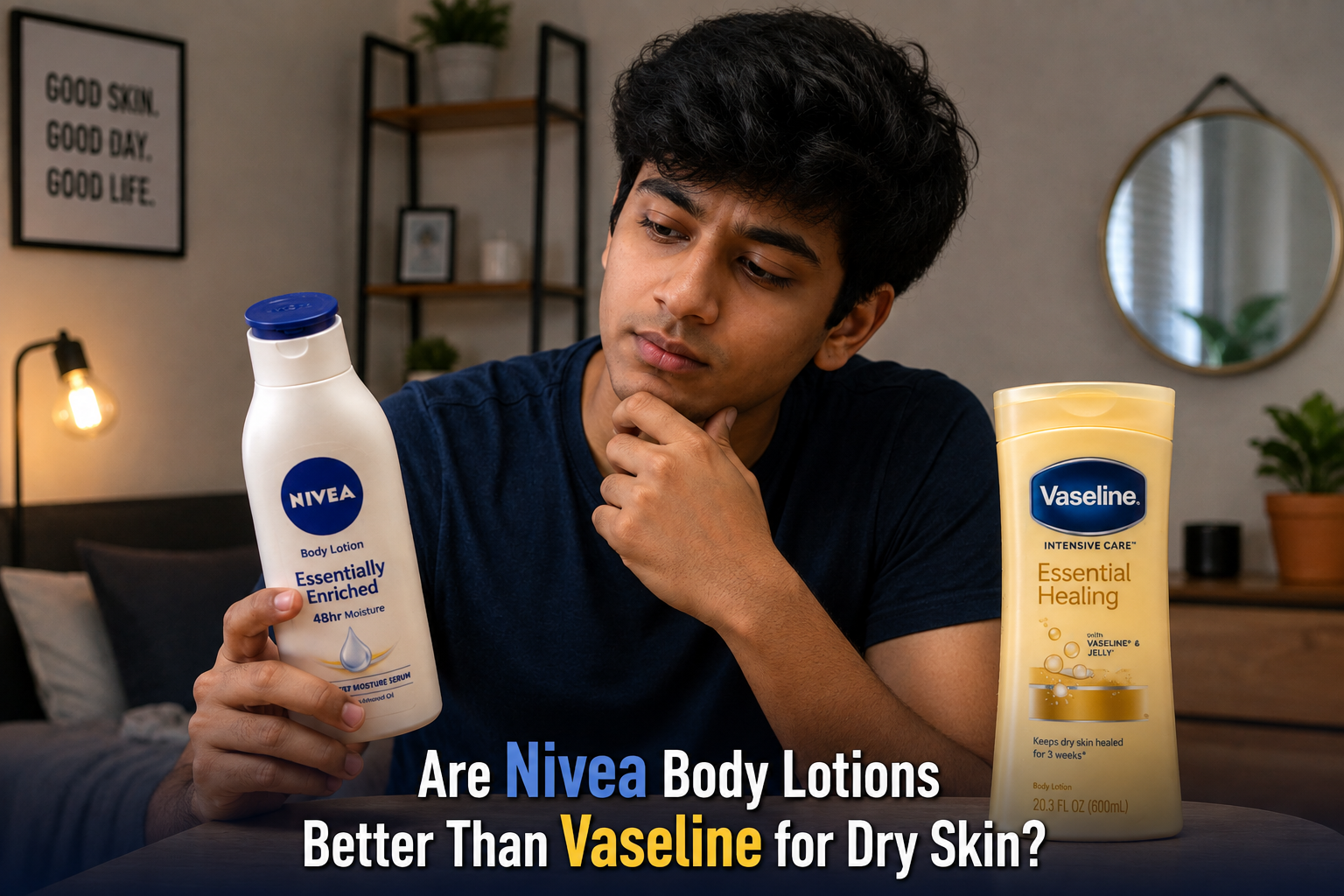
I am a Gen Z man. Are Nivea Body Lotions Better Than Vaseline for Dry Skin?
Last winter my hands cracked so bad at the knuckles that typing on my laptop actually hurt. Not “oh my skin feels a bit tight” dry. I mean visible white flaky skin on my forearms, and my elbows looked like I’d been dragging them across concrete. I’m 24, I’ve never had a daily skincare routine beyond “wash face, sometimes,” and suddenly I was googling “why is my skin peeling off my arms” at 1am like it was a medical emergency.
That’s basically how I ended up in the body lotion aisle for the first time in my life, standing there like an idiot comparing a blue Nivea tub to a jar of Vaseline, having genuinely no clue what the difference was supposed to be. If you’ve ever typed “Nivea vs Vaseline” into Google at midnight the way I did, you already know how confusing this gets.
If you’re a Gen Z guy who’s never had to think about skincare for men because your skin used to just handle itself, and now suddenly it doesn’t, this one’s for you. I tried Nivea body lotions and Vaseline lotions for a few months, made some dumb mistakes along the way, and I want to save you the trial and error.
Why Skin Just Stops Cooperating in Your Twenties (Nobody Warns You About This)
Nobody tells you this, but your skin genuinely changes as you get older, even in your twenties. Less oil production, more sensitivity to weather, and if you’re someone who showers in hot water every day like I was, you’re basically stripping your skin’s natural barrier without realizing it.
Winter dry skin is its own beast because central heating dries the air out indoors while cold wind does the same thing outside. Summer skincare has the opposite problem — AC blasting all day and constant sun exposure mess with moisture retention just as much, so this isn’t only a cold-weather issue. Either way, that’s when the dry patches, the flaky skin, and the weird tightness after showering all start showing up.
I genuinely thought I was just “getting old” at 24. Turns out I just needed an actual moisturizing lotion in my life.
First, What Nivea Body Lotions and Vaseline Lotions Actually Are
I assumed these two products basically did the same job. They don’t, not exactly, and understanding this made the whole Nivea Body Lotions vs Vaseline debate make a lot more sense.
Nivea body lotions (I used the classic blue tub, the Nivea Soft one, and later a bottle labeled specifically as Nivea for dry skin) are an actual moisturizing lotion. They’re water-based with oils and other ingredients mixed in, so they soak into your skin fairly fast and don’t leave much of a residue behind. It’s a genuinely lightweight body lotion, smells decent, and you can throw a shirt on right after applying without feeling gross.
Vaseline, on the other hand, is petroleum jelly. It’s not really a hydrating body lotion in the traditional sense — it doesn’t add moisture to your skin on its own. What it actually does is sit on top of your skin and lock in whatever moisture is already there, sealing it in so it can’t evaporate. That’s a completely different mechanism than what Nivea is doing, which is why Vaseline for dry skin works best as a sealant rather than a primary moisturizer.
Once I understood that difference, a lot of my confusion made sense. I’d been using Vaseline on completely dry skin expecting it to hydrate me on its own, and wondering why my arms still felt tight underneath the greasy layer. It wasn’t adding moisture, it was just trapping whatever little moisture I already had, which wasn’t much to begin with.
My Actual Experience Using Both
I want to be real with you instead of just repeating marketing lines, so here’s what genuinely happened over a few months of testing.
Week one, Nivea only: I used the Nivea Soft cream on my arms and legs after every shower, looking for that daily hydration boost. Within a few days the flaky skin on my forearms noticeably calmed down. It absorbed fast, felt non-greasy, and honestly smelled decent enough that I didn’t mind putting it on. My knuckles were still cracked though — this stuff felt too light for that level of rough skin.
Week two, Vaseline on my hands specifically: I started putting a thin layer of Vaseline lotion on my knuckles before bed, then wearing an old pair of cotton socks over my hands (yeah, I looked ridiculous, my roommate laughed at me for a solid week). By the fourth night, the cracking had genuinely healed up. That overnight sealing trick worked way better than I expected for the worst spots, and it delivered a kind of long-lasting moisture that regular lotion just couldn’t match on its own.
Weeks three onward, using both together: This ended up being the real answer for me. A moisturizing lotion all over after showering for general daily hydration, and a thin layer of Vaseline specifically on rough spots like knuckles, elbows, and heels, especially before bed. My skin has genuinely stayed in good shape since I started doing this combo.
The mistake I made early on was treating them as competitors, like I had to pick a winner in some Nivea vs Vaseline showdown. They’re actually solving two different problems, and using both together made way more sense than choosing one.
Step-by-Step: What I’d Actually Recommend Doing
If your skin is a mess right now and you want a simple daily skincare routine that doesn’t take more than two minutes:
- Shower with lukewarm water, not hot. I know hot showers feel amazing, especially during winter dry skin season, but they strip your skin’s natural oils fast. This alone made a noticeable difference for me.
- Pat your skin dry, don’t rub it. Sounds minor, but rubbing with a towel irritates already sensitive skin.
- Apply a body lotion for dry skin within a few minutes of getting out of the shower, while your skin is still slightly damp. It helps with moisture retention instead of applying to fully dry skin.
- For rough patches like elbows, knuckles, or heels, follow up with a thin layer of Vaseline over the areas that need extra help.
- At night, focus on hands and feet specifically. A thin coat before bed, especially if you can wear old socks or gloves over it, does a lot of heavy lifting while you sleep.
- Reapply lotion during the day if you wash your hands a lot. This one caught me off guard — I work with my hands a fair bit and kept undoing my progress by constantly washing them without reapplying anything.
Common Mistakes I Made (So You Don’t Have To)
Using too much Vaseline on my whole body. It’s genuinely too heavy and greasy for large areas like your arms and legs daily. Save it for small, stubborn spots.
Skipping my skin moisturizer on days my skin felt “fine.” Dry skin doesn’t happen instantly, it builds up over days of neglect. Consistency mattered way more than intensity.
Applying lotion to fully dry skin. Damp skin locks moisture in better. This small change made a bigger difference than I expected.
Not checking ingredients for fragrance-heavy formulas. Some Nivea variants are more fragranced than others, and if you have sensitive skin that’s already irritated, a heavily scented one can sometimes make things worse. The fragrance-free versions are worth trying if regular formulas bother you.
Thinking one product had to “win.” Like I said earlier, this isn’t really a competition. They do different jobs.
Real Talk: What’s the Best Body Lotion for You
If you just want one everyday product for general dryness across your body, get a Nivea body lotion, ideally one labeled for dry skin. It’s a fast-absorbing, non-greasy body lotion, doesn’t ruin your shirt if you put clothes on right after, and works well as part of a daily skincare routine.
If you’ve got specific rough skin patches, like knuckles, heels, or elbows that feel almost leathery, a small jar of Vaseline is worth having around specifically for those trouble zones, especially overnight.
Honestly, the combo is what actually fixed my skin, not picking a side between Nivea Body Lotions vs Vaseline. A tub of each costs practically nothing compared to how much better my hands feel typing this without cracking apart. And if you’re building out Gen Z men skincare habits from scratch like I was, starting with these two basics before buying anything fancier is genuinely enough for most people.
One Thing Worth Mentioning
If your skin isn’t improving after a few weeks of consistent moisturizing, or if you notice redness, itching, or cracking that keeps getting worse instead of better, that’s worth a quick visit to a dermatologist rather than just cycling through more products. Sometimes what looks like ordinary dry skin is actually eczema or something else that needs a different kind of treatment, and no amount of lotion is going to fix that on its own.
Final Thoughts
I genuinely didn’t expect to become someone who has opinions about moisturizer, but here we are. If you’re dealing with dry skin and feeling a bit lost standing in that aisle like I was, don’t overthink it. Grab both, use them for what they’re actually good at, and give it a couple of weeks before judging results. Your skin didn’t get dry overnight, so it’s not going to fix itself overnight either, but the difference is honestly noticeable faster than you’d think.
Visit TheGlobalMag.org for more the latest insights.