10 Things to Check Before Buying a Side Locker Tool Box
The first Side Locker Tool Box I bought looked perfect in the photos.
It had plenty of drawers, a solid-looking frame, and enough space to make my workshop feel instantly more organised. The problem only showed up after I started using it. One drawer became difficult to open when it was loaded with sockets and spanners. The wheels also struggled when I moved the box across an uneven garage floor.
That experience taught me something simple: a side locker tool box can look impressive and still be inconvenient to use.
If you’re looking for a side locker tool box for workshop use, it is worth spending a little more time checking the practical details. A good side locker tool cabinet should make your work easier, provide useful tool storage, and fit naturally into your existing workshop setup.
This side locker tool box buying guide covers the things I would check before spending money on one.
1. Check the overall size first
Before looking at drawers, locks, colours, or accessories, measure the space where you intend to put the tool box.
This sounds obvious, but it is an easy step to skip.
A side locker cabinet can be wider than expected because the side section adds extra depth or width to the main unit. In a small garage, even a few extra centimetres can make a noticeable difference.
Before buying a side locker tool box, measure:
- Available floor width
- Available depth
- Ceiling or overhead clearance
- Space needed to open drawers
- Space needed to walk around the box
- Distance from nearby workbenches or vehicles
Remember that the stated dimensions usually describe the outside of the cabinet. The usable storage space will be smaller.
I once measured a space based only on the main cabinet and forgot to allow enough room for the side section. It technically fitted, but moving around it was awkward.
A tool box that fits perfectly on paper may not work well in the real space.
This is especially important when planning garage tool storage. A cabinet that blocks a walkway or makes it difficult to open a vehicle door isn’t really saving space.
2. Look at the drawer capacity
The number of drawers is not the most important thing.
What matters is how much useful equipment each drawer can safely carry.
A tool cabinet with drawers is useful for organising sockets, spanners, screwdrivers, pliers, and smaller workshop equipment. But heavy tools such as socket sets, ratchets, hammers, impact accessories, and large spanners can add up to a surprising amount of weight.
Check the manufacturer’s stated drawer capacity if it is available.
Also look at the drawer construction. Thicker drawer sides and stronger runners are generally preferable for heavy workshop use.
I learned this the annoying way. I used one large drawer for sockets and accessories because it was convenient. After a while, it became noticeably harder to pull open.
Now I spread heavy tools across several drawers instead of putting everything in one place.
When comparing a side locker tool box, don’t just count how many drawers you get. Check their height, width, depth, and weight rating.
3. Pay attention to the drawer slides
Drawer slides are easy to ignore when you’re comparing tool boxes, but they have a huge effect on everyday use.
Open and close the drawers several times if you’re viewing the box in person.
They should move smoothly without excessive side-to-side movement. When a drawer is pulled out, it should also feel reasonably stable.
Ball-bearing slides are commonly used on workshop tool cabinets and can provide smooth movement, but the quality of the whole drawer system still matters.
Don’t assume that two tool boxes with similar-looking slides will perform identically.
If you’re buying online, look closely at product photographs and specifications. User reviews can also be useful because people often mention drawer problems after months of use.
That kind of feedback is much more useful than a product description saying that the drawers are “premium.”
4. Check the weight rating of the side locker
The side locker is often where people store larger or less frequently used tools.
That makes its load capacity particularly important.
A heavy duty side locker can be useful for professional workshops or anyone storing heavier equipment. However, don’t assume that a cabinet is heavy duty simply because it looks large.
Check the actual specifications.
Think about what you plan to put inside it.
For example, you might use the locker for:
- Power tools
- Cordless drills
- Sanders
- Spare batteries
- Larger hand tools
- Cleaning equipment
- Electrical accessories
- Vehicle maintenance equipment
Don’t judge capacity by physical volume alone.
A cabinet might have plenty of space but still have a relatively modest weight limit. Heavy power tools can quickly change the equation.
If the manufacturer provides separate load ratings for shelves, drawers, or the entire cabinet, check each one rather than relying on a single overall figure.
5. Check the locking system
A lockable side locker is useful even if your workshop is normally secure.
You may have expensive drills, batteries, diagnostic equipment, or specialist tools inside the cabinet. Keeping everything behind a lock adds another layer of protection when you leave the garage or workshop.
Check how the locking mechanism actually works.
Some cabinets use a central locking system that secures several drawers at once. Others have separate locking arrangements.
Also check whether the keys are replaceable or whether the manufacturer provides replacement keys.
This sounds like a minor detail until you lose one.
I also prefer a locking system that feels solid rather than one that seems like it was added as an afterthought. A thin lock doesn’t inspire much confidence on a cabinet built to store expensive equipment.
6. Don’t ignore the wheels and casters
If the tool box is going to stay in exactly one position, wheels may not seem important.
But most people eventually move their cabinet.
Maybe you need to clean behind it. Perhaps you’re working on a vehicle in another part of the garage. Or you simply want to rearrange the workshop.
A mobile side locker can make this much easier.
Check the caster size and construction.
Larger casters generally handle uneven surfaces better than very small wheels. Locking casters are also useful because they stop the cabinet from moving while you’re opening heavy drawers.
Before buying, think about your actual floor.
A smooth workshop floor is easy. A rough concrete garage floor is a different story.
A cabinet that rolls beautifully across a showroom floor might be much harder to move over cracks, thresholds, or rough concrete.
If possible, push the box before buying it.
7. Look at the available storage layout
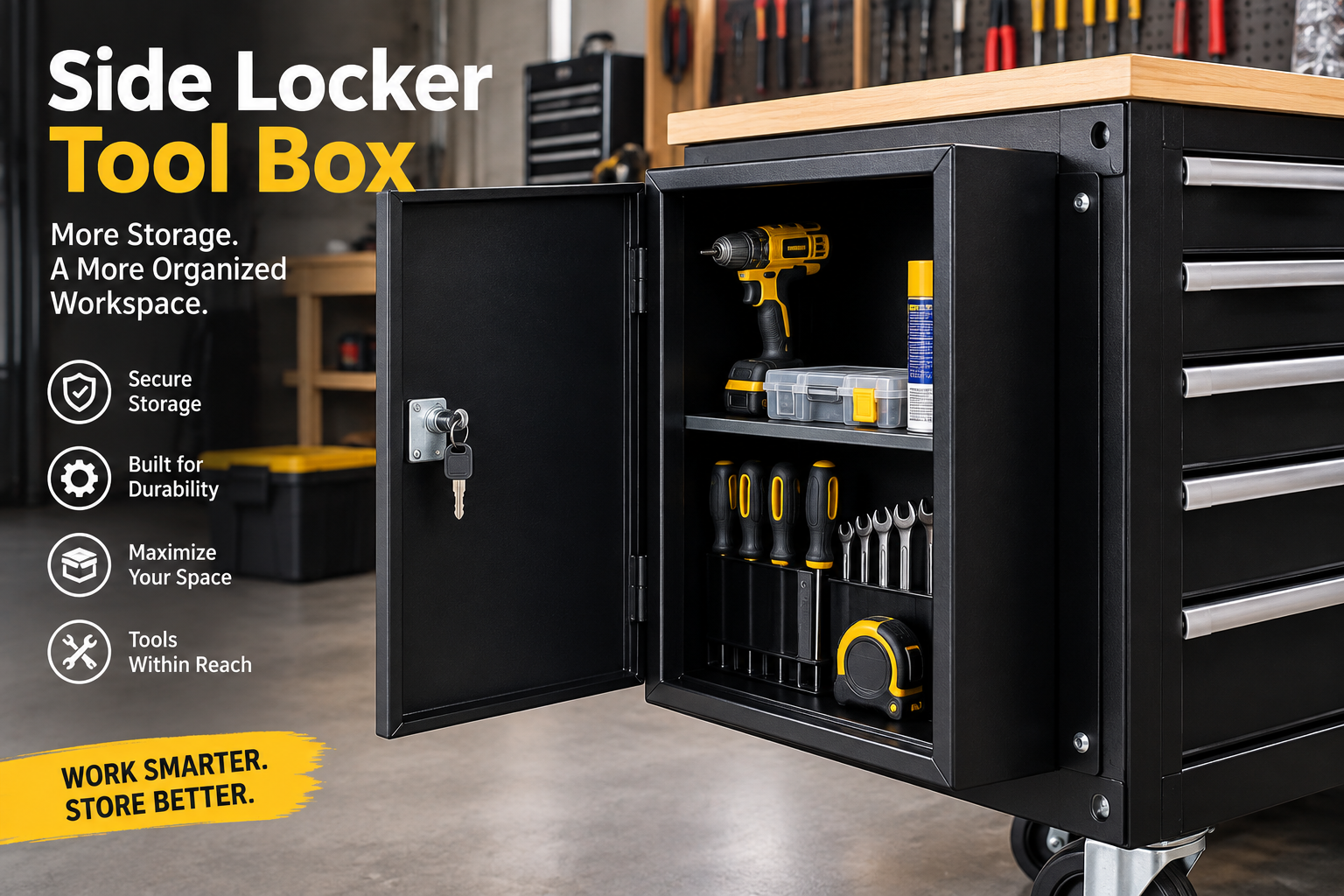
A side locker tool box is useful because it gives you additional storage without taking up the same amount of floor space as a completely separate cabinet.
But the layout needs to suit your tools.
Take a look at shelf height and internal clearance.
Will your cordless drill fit comfortably?
Can you store a toolbox or case inside?
Is there enough vertical space for bottles, spray cans, or larger equipment?
Are the shelves adjustable?
These questions matter more than the number printed on the product listing.
For example, a cabinet may have three shelves, but if the shelf spacing is fixed and one section is too short for the items you own, part of that storage becomes wasted.
Before buying, make a quick list of the five or ten largest things you want to store. Compare their dimensions with the cabinet’s internal measurements.
It takes a few minutes and can prevent a lot of frustration.
Good side locker tool storage should make it easier to separate larger equipment from the hand tools you use every day.
8. Check the construction quality
A tool cabinet doesn’t need to be indestructible, but it should be built for the environment where it will be used.
Look at the steel thickness if the manufacturer provides it. Also inspect the corners, drawer fronts, handles, hinges, shelf supports, and mounting points.
If you’re shopping in person, open the doors and drawers and give the cabinet a careful look.
You don’t need to become an engineer.
You’re simply looking for signs that the cabinet has been made properly.
Thin panels that flex excessively, poorly aligned doors, loose handles, or rough drawer movement would make me cautious.
A metal side locker can be a practical option for workshop storage, while a steel side locker may be preferable when you need a stronger cabinet for regular heavy-duty use. Don’t rely on the material name alone, though. Steel thickness and overall construction still matter.
Paint and powder coating are worth checking too. A workshop cabinet will eventually get scratched. A reasonable protective finish can help it cope with everyday use.
9. Think about how the side locker attaches to the main cabinet
This is one of the details I would pay more attention to than I used to.
If the side locker is designed to attach to a main tool chest and side locker setup, check exactly how the two units connect.
A secure connection makes the complete setup feel more like one working system. A poor connection can leave the side cabinet feeling unstable or awkward.
Check whether mounting hardware is included.
Also check whether the side locker can be positioned on either side of the main cabinet. That can be useful if you change your workshop layout later.
Don’t assume compatibility just because two products are from the same general category.
A tool chest side locker combination can be excellent for expanding storage, but check the manufacturer’s specifications for the exact models.
If you’re mixing brands, be especially careful.
A cabinet might look compatible but have different mounting points or dimensions.
10. Consider your tools before your budget
Price matters, but buying the cheapest cabinet isn’t always the cheapest decision.
Think about what you already own and what you expect to buy over the next few years.
If you’re building a workshop from scratch, you may start with a basic collection of screwdrivers, pliers, sockets, and wrenches. Six months later, you might have added a drill, impact wrench, multimeter, torque wrench, inspection light, and several specialist tool sets.
Storage requirements grow surprisingly quickly.
I’d rather buy a slightly larger workshop storage cabinet once than replace a small one because it became overcrowded.
At the same time, don’t pay for storage you will never use.
If you only have a small collection of hand tools, a huge professional cabinet may simply take up space without giving you much practical benefit.
The right size is the one that gives you some room to grow without dominating your workshop.
How I Would Check a Side Locker Tool Box Before Buying
If I were standing in a shop with several models in front of me, I’d go through them in this order.
Measure the space:
Take measurements at home first.
Write them down on your phone rather than trying to remember them.
Make a tool list:
List your largest and heaviest tools.
Don’t forget tool cases, batteries, chargers, and accessories.
Check the internal dimensions:
Compare your list with the actual storage space.
Ignore impressive-looking external dimensions if the inside doesn’t work for your equipment.
Test every drawer:
Pull them open.
Close them.
Try several drawers at once.
Pay attention to movement, alignment, and how the cabinet feels when the drawers are extended.
Test the wheels:
Push the cabinet if the retailer allows it.
Lock the casters and see whether it stays firmly in place.
Check the lock:
Make sure the locking mechanism operates smoothly and doesn’t feel excessively loose.
Check the specifications:
Look for drawer capacity, shelf capacity, cabinet dimensions, material information, and warranty details.
Read long-term reviews:
Don’t just look at the overall star rating.
Search reviews for terms such as “drawer,” “caster,” “lock,” “rust,” “hinge,” and “after a year.”
Those comments can reveal problems that aren’t obvious when the cabinet is new.
Side Locker Tool Box Storage: How to Plan It Properly
The biggest benefit of a side locker isn’t simply having another place to put things.
It is being able to divide your workshop tool storage into logical areas.
For example, you could keep frequently used hand tools in the main chest while storing larger equipment in the side cabinet.
A simple arrangement could look like this:
Main tool chest:
- Sockets
- Spanners
- Screwdrivers
- Pliers
- Measuring tools
- Small accessories
Side locker:
- Power tools
- Battery chargers
- Larger cases
- Specialist equipment
- Spare accessories
- Less frequently used tools
This makes tool box storage much easier to manage.
It also prevents the main drawers from becoming overloaded.
Side Locker Tool Box vs. Separate Storage Cabinet
If you’re trying to improve garage storage, you may be wondering whether a side locker is better than buying a completely separate cabinet.
A side locker tool box has one obvious advantage: it can extend an existing setup without requiring another full-size tool cabinet.
If you already have a tool chest, adding a side tool cabinet can give you extra vertical storage while keeping your main tools together.
A separate garage storage cabinet, on the other hand, may give you more flexibility if you need to store bulky equipment away from your main workstation.
Think about how often you’ll need to access the items.
Tools you use constantly should stay close to your main work area. Equipment you only use occasionally can go into a larger storage cabinet.
What should you store in a workshop side locker?
A workshop side locker is particularly useful for items that don’t need to be accessed every few minutes.
For example, you could keep larger power tools, spare accessories, electrical equipment, cleaning supplies, vehicle tools, or less frequently used equipment there.
Your main drawers can then hold the tools you reach for constantly.
That simple division can make a workshop feel much more organised.
Instead of opening five drawers looking for one tool, you start to know exactly where things belong.
For mechanics, this can be especially useful as mechanic tool storage tends to grow quickly. Impact tools, diagnostic equipment, sockets, torque wrenches, extension bars, and vehicle-specific tools can take up considerable room.
Common mistakes to avoid
Buying based only on appearance
A glossy finish and lots of drawers can make a cabinet look impressive.
But appearance won’t help if the drawers are too shallow or the cabinet is difficult to move.
Forgetting the side clearance
Measure the complete footprint, not just the main chest.
Remember that doors and drawers need room to open.
Overloading one drawer
Heavy tools should be distributed rather than piled into one drawer.
This can make the cabinet easier to use and reduce unnecessary strain on the drawer hardware.
Ignoring future storage needs
You don’t need to predict everything you’ll ever buy.
But leaving some spare capacity is sensible.
A completely full tool cabinet becomes difficult to organise very quickly.
Assuming all tool boxes are compatible
If you already have a tool chest and want to add a side locker, check the manufacturer’s compatibility information.
Don’t rely on appearance alone.
Forgetting maintenance
Even a good steel cabinet needs some basic care.
Wipe away oil and moisture rather than leaving them sitting on the surface. Keep drawer slides clean and avoid forcing a drawer that has become obstructed.
If the workshop is damp, pay attention to early signs of corrosion.
How to choose the right side locker tool cabinet with drawers
If you’re still comparing models, I would narrow the decision down to five questions:
- Does it fit the available space?
- Can the drawers handle the weight of your tools?
- Does the storage layout suit the equipment you own?
- Is the cabinet easy to move and secure?
- Can it grow with your workshop?
A side locker cabinet with drawers can be a particularly useful choice if you need both enclosed storage and quick access to smaller tools.
Look for a design that gives you a useful mixture of shelves, drawers, and enclosed compartments rather than simply choosing the model with the highest drawer count.
Final thoughts
Buying a side locker tool box isn’t really about finding the cabinet with the most drawers or the biggest-looking frame.
It’s about finding one that fits your space, handles the weight of your tools, rolls properly on your floor, and gives you storage that actually matches the way you work.
The biggest lesson I learned is to think about the tools first and the cabinet second.
Measure the space. Check the drawer capacities. Test the slides and wheels. Look at the locking system. Check how the side locker connects to the main unit.
Most importantly, imagine yourself using it six months from now, not just opening the box for the first time.
That’s when the small details start to matter.
A well-planned side locker tool storage setup can turn a crowded garage into a much more practical workspace without requiring a complete workshop makeover.