Aircraft Carrier: How the World’s Largest Warships Work
Stand on the edge of a pier next to an aircraft carrier and the first thing you notice is the scale. The hull rises like an office tower laid on its side, and the flight deck above it is longer than three football fields. It is easy to see why navies treat these ships as the ultimate expression of sea power and naval power projection. An aircraft carrier is not just a big boat with planes on top. It is a mobile airbase, a command center, a small city and a diplomatic statement, all moving across the ocean at more than 30 knots, which is why the largest aircraft carriers in the world are often called supercarriers.
This guide walks through what an aircraft carrier is, its history, how aircraft carriers work, how many carriers are in service worldwide, and where the technology is heading.
What Is an Aircraft Carrier?
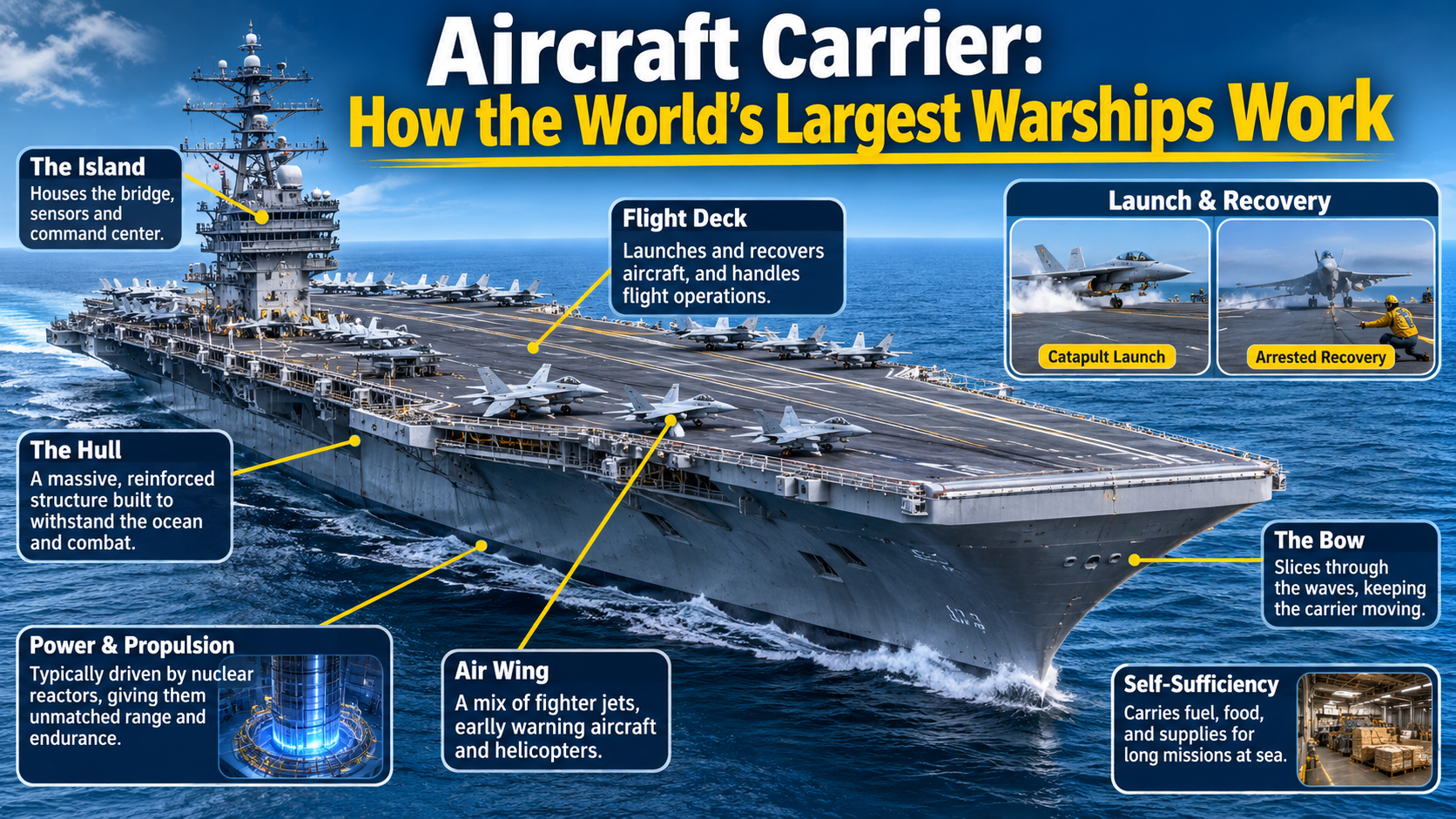
An aircraft carrier is a warship built to carry, launch and recover military aircraft at sea. Its defining feature is the long, flat flight deck, which acts as a runway, while the hangar below stores and maintains the aircraft. The ship itself carries relatively few weapons of its own. Its real firepower is its carrier air wing, the core of naval aviation: fighters such as the F/A-18 Super Hornet, strike aircraft, early-warning planes like the E-2D Hawkeye, helicopters and, increasingly, unmanned aerial vehicles.
That design gives a navy something no land base can match: reach without permission. A carrier does not need to ask a foreign government for runway access. It simply sails into international waters and brings its airfield along.
A Short History
The idea of flying aircraft from ships is older than most people expect. In 1910, American pilot Eugene Ely took off from a platform built on the cruiser USS Birmingham, and a few months later he landed on a similar platform on USS Pennsylvania. These were crude experiments, but they proved the concept.
The first true carriers appeared around the end of World War I. Britain’s HMS Argus, converted from an ocean liner, was the first ship with a continuous flat deck for takeoffs and landings. Through the 1920s and 1930s, Britain, Japan and the United States all built carriers, and each navy learned hard lessons about deck design, hangar layout and aircraft handling.
World War II changed everything, turning aircraft carriers into the centerpiece of naval warfare. The attack on Pearl Harbor was launched from Japanese carriers, and the Pacific war that followed was decided largely by carrier battles such as the Battle of the Coral Sea and the Battle of Midway. At Midway in 1942, American carrier aircraft sank four Japanese carriers in a single engagement, and the battleship, once the queen of the seas, was quietly demoted. After the war, carriers only grew: angled decks, steam catapults and jet aircraft arrived in the 1950s, followed by nuclear propulsion with USS Enterprise, the first nuclear-powered aircraft carrier, in 1961.
Anatomy of a Carrier
Every part of the ship exists to move aircraft safely and quickly.
The flight deck. The aircraft carrier flight deck is the busiest and most dangerous workplace in the military. Aircraft launch from one end while others land on an angled section, so a plane that misses the arresting wires can throttle up and fly off again rather than crashing into parked aircraft.
Catapults and arresting gear. On most large carriers, a steam catapult or an electromagnetic aircraft launch system (EMALS) hurls a fighter from standstill to over 150 miles per hour in about two seconds. When landing, a pilot aims to catch one of several steel arresting wires stretched across the deck with a tailhook. The cable brings a 20-ton jet to a stop in roughly 300 feet. It is controlled chaos, repeated dozens of times a day.
The island. The tower on the starboard side houses the bridge, flight control and the ship’s radar and communications gear. It is deliberately small to leave as much deck space as possible.
The hangar and elevators. Below the flight deck, the hangar bay is where aircraft are stored, repaired and refueled. Huge elevators lift them to the deck when needed.
The crew. A large nuclear carrier may carry around 5,000 people when the air wing is aboard. They cook, repair, refuel, arm, navigate, treat patients and run the reactors. Many of the deck crew are in their early twenties, wearing color-coded jerseys that signal their jobs: yellow for aircraft directors, red for ordnance, purple for fuel, and so on.
Types of Aircraft Carriers
Not every carrier looks like the American supercarriers, and the differences come down to how aircraft leave the deck.
CATOBAR (catapult-assisted takeoff, barrier-arrested recovery) is the most capable arrangement. It lets heavy, fully loaded aircraft launch and return. The United States and France operate this type, and China’s newest carrier uses it too.
STOBAR (short takeoff, barrier-arrested recovery) uses a ski-jump ramp instead of catapults. Aircraft take off under their own power, which limits weapon and fuel loads, but the ships are simpler and cheaper. Russia, India and China have used this design.
STOVL (short takeoff, vertical landing) carriers operate jets like the F-35B Lightning II, which can land vertically like a helicopter. Britain’s Queen Elizabeth-class aircraft carriers (HMS Queen Elizabeth and HMS Prince of Wales) and several amphibious assault ships fall into this group.
Then there are helicopter carriers and amphibious assault ships, which often look like carriers but focus on landing troops and supporting operations ashore. Japan has converted some of these ships, such as the Izumo class, to operate F-35B jets, blurring the old categories.
Nuclear vs. Conventional Power
The United States Navy operates only nuclear-powered aircraft carriers. A reactor lets a ship steam for decades without refueling and frees up huge internal space that would otherwise hold fuel for the ship, leaving more room for aviation fuel and weapons. The tradeoff is cost and complexity: nuclear carriers are extremely expensive to build, maintain and eventually decommission.
Most other navies use conventional propulsion, either gas turbines or diesel, which is cheaper but ties the ship to regular refueling. France’s Charles de Gaulle is the notable exception, as the only nuclear-powered carrier outside the US fleet.
The Carrier Strike Group
A carrier never sails alone. It operates as the center of a carrier strike group, typically including Aegis guided-missile cruisers and destroyers, a supply ship and often an attack submarine. The escorts defend against missiles, aircraft and submarines, while the carrier provides the offensive punch.
This layered defense is a big part of why carriers are hard to sink. Threats have to get through fighter patrols, radar picket aircraft, missile interceptors and electronic countermeasures before they ever reach the carrier itself.
Who Has Carriers Today?
The United States dominates, with eleven large carriers, including the Nimitz-class supercarriers and the new Gerald R. Ford class (led by USS Gerald R. Ford), which uses electromagnetic launch systems in place of steam catapults. The cost of an aircraft carrier is staggering: each Ford-class ship costs well over ten billion dollars.
China’s People’s Liberation Army Navy has expanded quickly, commissioning Liaoning, Shandong and the catapult-equipped Fujian, its most advanced aircraft carrier. The Indian Navy operates INS Vikramaditya and the domestically built INS Vikrant. Britain’s Royal Navy has two Queen Elizabeth-class carriers, France has the Charles de Gaulle, and Russia’s aging Admiral Kuznetsov has spent years in repair. Italy, Spain and a few others operate smaller carriers.
For many countries, owning a carrier is as much about prestige and influence as raw capability. It signals that a nation can project power far from its own coastline.
What Carriers Are Used For
The public mostly imagines carriers in wartime, but much of their work is quieter. They conduct air strikes, enforce no-fly zones and protect shipping lanes. They also serve as a visible deterrent: moving a carrier toward a crisis is one of the clearest shows of force a government can make without firing a shot.
Carriers also provide humanitarian assistance and disaster relief (HADR). With their desalination plants, hospitals, helicopters and thousands of trained personnel, they have delivered relief after tsunamis, earthquakes and hurricanes.
Criticisms and Vulnerabilities
Carriers have plenty of critics. The cost is enormous, and a single ship represents a large share of a navy’s budget. Some analysts argue that anti-ship ballistic missiles (often called carrier killers), hypersonic weapons, advanced submarines and swarms of cheap drones threaten to make carriers too vulnerable to risk near a capable adversary’s coast.
Defenders respond that carriers are among the best-protected assets in any fleet, that no other platform offers comparable flexibility, and that every weapon ever predicted to kill the carrier has so far been met with countermeasures. The debate is real and ongoing, and it shapes procurement decisions around the world.
The Future of the Aircraft Carrier
The next generation of carriers is already taking shape. Electromagnetic catapults offer smoother launches and less stress on airframes. Unmanned aircraft, from the MQ-25 Stingray refueling tanker to surveillance drones, are being integrated into air wings, extending the range and reducing risk to pilots. Directed-energy weapons, better sensors and artificial intelligence may help defend the ships and streamline deck operations.
What probably will not change is the underlying logic. As long as nations want to operate far from home, protect trade routes and respond quickly to crises, there will be a role for a ship that carries its own runway.
Final Thoughts
The aircraft carrier is one of the most complex machines humans have ever built. It combines naval engineering, aviation, nuclear power and the daily work of thousands of people into a single moving platform. Whether you see it as a symbol of stability, an expensive relic or a necessary tool of modern defense, there is no denying its influence on the last century of history, and likely the next.
Discover more trending topics and engaging reads at TheGlobalMag.com.